uVersion
English
Download →

Wiki

Users

Create and manage uVersion accounts: roles, password, deactivation, permanent deletion, licence seats. Who can do what between super admin and project_admin.

Introduction
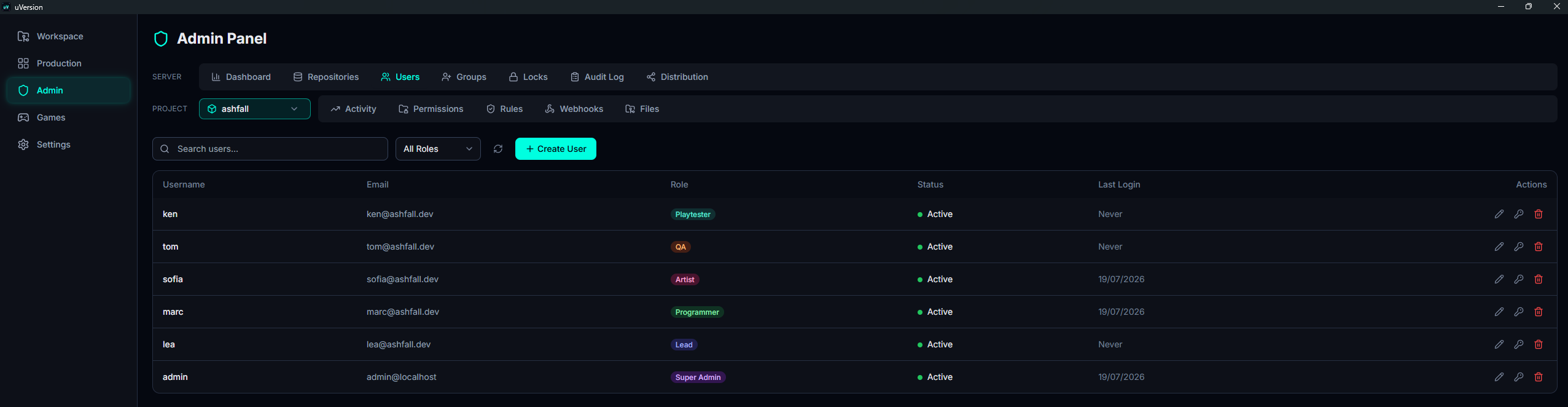
The Users tab of the admin panel is where you create accounts, assign them a role, reset a password, deactivate or reactivate an account, and delete it permanently. For each user the list shows their name, their email, their role, their status (Active / Inactive) and their last login.

It lives in the SERVER row of the panel, the one that concerns the whole server, and not in the PROJECT row which concerns only the repository selected right beside it: an account belongs to no project.

The role is the label that says what an account is allowed to do on the server (admin, artist, viewer, etc.). It is assigned here, and its detail is explained in Roles & admin panel. A repository is a project versioned on the server; a lock is the reservation a user places on a file while they are modifying it.

Who sees what, who can do what

Two roles open this tab, and they do not have the same actions there.

Super admin (admin role)

They see every account and have every action available: create, edit, reset the password, deactivate, reactivate, delete.

project_admin

Their list is not scoped: as soon as they administer at least one repository, they see every account except the super admins, with their email, their status and their last login. This is deliberate: managing people's roles assumes knowing who exists. If they administer no repository, they see nobody and can act on nobody.

What they can do:

  • Create an account, with a role strictly below their own.
  • Edit an existing account (Edit button): its email and its role. The new role is capped strictly below their own: never admin, never lead, never another project_admin.

What they cannot do:

  • Act on a super admin, who does not even appear in their list.
  • Reset a password: choosing someone's password amounts to being able to log in as them and inherit all their access.
  • Toggle Active / Inactive: deactivation cuts access to all of the server and moves the licence seat counter, which is beyond the scope of a project.
  • Delete an account.
A project_admin can demote a lead A lead ranks above a project_admin, so the latter cannot assign the lead role. But nothing stops them from selecting an account that is already lead and giving it a lower role: the cap applies to the role assigned, not to the current role of the target. Only entrust the project_admin role to people you trust.

Create a user

1. Open the Users tab

In the sidebar, open Admin, then the Users tab of the SERVER row. The toolbar carries a search field, an All Roles filter and, on the far right, the + Create User button. Below it, the table lists the existing accounts.

The Users tab of the admin panel, in the SERVER row: the toolbar with the Search users field, the All Roles filter and the Create User button on the right, then the Username / Email / Role / Status / Last Login / Actions table.

2. Open the creation form

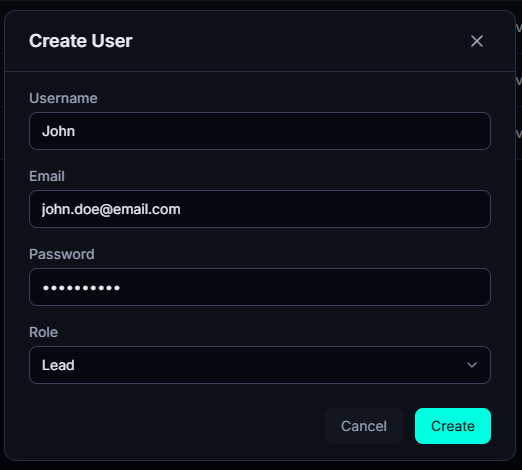
Click + Create User. A Create User window opens with four fields, all empty except the Role selector, which defaults to user.

The Create User window: the Username, Email and Password fields, the Role selector set to user, and the Cancel and Create buttons.

3. Fill in the fields and confirm

FieldConstraint
Username1 to 100 characters, unique. It can no longer be changed afterwards.
EmailNot empty, must contain @, unique.
PasswordAt least 8 characters.
RoleOne of the 9 roles. Defaults to user.

A username or an email already taken is rejected (conflict error).

Click Create. The account is active immediately and at once consumes a licence seat.

Choosing the role

The selector lists all 9 roles, but you can only assign a role strictly below your own rank. A lead therefore cannot create an admin, and nobody can create an account of a rank equal to or higher than their own. See Ranks and guard.

Edit an account
1. Spot the actions on the row

Everything starts from the Actions column, on the right of the account's row. They are textless icons, and they are not all visible to everyone:

  • Pencil (Edit): opens the edit window. It is the only action open to a project_admin.
  • Key (Reset Password): super admin only.
  • Green check (Reactivate): super admin only, and only on the row of an inactive account.
  • Red trash (Delete): super admin only, on an active account as well as an inactive one.
Close-up of the Actions column of the user list, over two rows: an Active-status row showing the Edit pencil, the Reset Password key and the red Delete trash, and an Inactive-status row that additionally shows the green Reactivate check.

2. Change the email or the role

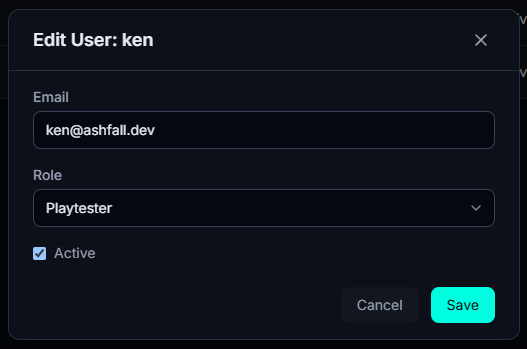
The pencil opens the Edit User window, which carries the account name in its title. It contains:

  • Email: editable.
  • Role: editable, within the limit of the rank of whoever is editing (see above).
  • Active: the checkbox that activates or deactivates the account. It appears only for a super admin. A project_admin does not see it and the server would refuse it anyway.

The username cannot be changed: it identifies the account throughout the whole history, so there is no field for it.

The Edit User window seen by a super admin: the Email field, the Role selector, the Active checkbox ticked, and the Cancel and Save buttons. The username is not a field.

3. Save

Click Save. The change is applied at once, with no restart and no delay.

Immediate effect Changing an account's role immediately revokes its current sessions: a demotion or a promotion takes effect at once, without waiting for the token to expire naturally (up to 30 days otherwise).

Two safeguards apply to yourself: you can neither demote yourself ("Cannot demote yourself"), nor deactivate yourself ("Cannot deactivate yourself").

The same window seen by a project_admin

A project_admin opens the same window, with the email and the role, but without the Active checkbox: they can neither suspend nor reactivate an account. Their role selector also stays capped strictly below their own rank.

The same edit window seen by a project_admin: email and role only, without the Active checkbox.

Reset the password

Reserved for the super admin.

1. Open the reset window

On the account's row, click the key icon (Reset Password), the second in the Actions column. The window carries the account name in its title: this is the moment to check you are aiming at the right one.

2. Enter the new password

The New Password field expects at least 8 characters, otherwise the confirm button stays inactive. Finish with Reset Password.

Every session of the account falls As with a role change, the reset revokes all existing sessions: the old password and the tokens already issued stop working on the spot, in the desktop client, in the Unreal editor and on the command line. Warn the person, or they will see an unexplained sign-out.

Deactivate, reactivate

Deactivating an account is suspending it without destroying anything: the person can no longer log in, but the account, its name and its access stay in place and you can reactivate it later. This is what to do for a temporary departure, a finished internship, or a contractor between two assignments.

There is no "Deactivate" button Deactivation is done by unticking the Active checkbox in the edit window (pencil icon), then Save. This checkbox is reserved for the super admin.

1. Deactivate

Pencil icon on the account's row, untick Active in the window shown above, then Save. The person is signed out of all their clients and can no longer log in. You cannot deactivate yourself.

2. Reactivate

A Reactivate button (green check) appears on the row of inactive accounts, and on them only. It is visible only to a super admin, and reactivation consumes a licence seat again: it fails if the quota is full.

A deactivated account keeps its history (who committed what) and lets the person come back without recreating an account.

Delete an account

Deletion is permanent and cannot be reactivated Contrary to what "soft delete" might suggest, the Delete button does not merely deactivate the account: it erases its identity for good. There is no button to go back, and any attempt to reactivate it is refused by the server with the message "This account was deleted and can no longer be modified". To simply suspend someone, use deactivation.

1. Click the trash icon

The Delete button (red trash, the last icon in the Actions column) is reserved for the super admin and shows on both an active account and an already deactivated one.

2. Read the confirmation, then confirm

The Delete User window names the account targeted, lists what is going to be erased and reminds you that you must untick Active to only suspend someone. Read it: it is the last stopping point, the Delete button asks nothing more after that.

The Delete User confirmation window, whose text lists everything that is erased and reminds you to untick Active to only suspend.

What deletion erases

In a single transaction:

  • The username is replaced by an anonymous identifier of the form deleted_42, and the original name therefore becomes available again for a new account.
  • The email is erased and the password made unusable.
  • The sessions are revoked: the account is signed out of all its clients immediately.
  • Its locks are released, which makes its files editable again by the team.
  • All its permissions, its group memberships, its project_admin rights and its build access are removed.
  • Its task assignments, its file watches and its pending notifications are removed.
  • The account disappears from the list of users.

What survives, deliberately: the history. Its commits, its audit entries, its tasks and its comments stay in place, attributed to a deleted account. Nothing is rewritten in the repository.

Two refusals to know about: you cannot delete yourself, and if an account already carries the reserved name (deleted_<id>), deletion is refused with a message that tells you which one to remove first. A super admin can, however, delete another super admin: it is the only way to remove a second super admin created by mistake.

Licence seats

Creation and reactivation consume a seat Every active account occupies a seat on the server licence. If the quota is reached, creating a new user or reactivating one fails with an explicit error (and not silently). Free a seat by deactivating an account, or increase the number of seats from your licences area.

Common pitfalls

Reactivation refused even though the account exists

Two possible causes, and the message tells them apart:

  • "seat limit": the seat quota is full. Deactivate another account first, or add seats.
  • "This account was deleted and can no longer be modified": the account was deleted, not deactivated. It is not recoverable. Recreate an account; its old username is available again.

"I don't see a user in my list"

Three causes, and three only:

  • It is a super admin and you are a project_admin: super admins are hidden from your list, since you cannot act on them anyway.
  • The account was deleted: it will never reappear.
  • You are a project_admin and you no longer administer any repository: in that case your list is entirely empty. Ask a super admin to attach you to a project.

Outside these three cases, a project_admin sees every account on the server: there is no need to grant them a permission to make one visible.

A role change does not "take"

The change is immediate on the server side, but the affected user is signed out: they must log back in for their client to reflect the new role.

"I tried to suspend someone and the account disappeared"

You used Delete instead of unticking Active. Deletion is permanent: the account is not recoverable and will have to be recreated, then its permissions, its groups and its build access reassigned one by one. Its commit history, though, is not lost.